

When Liferay announced the beta availability of its new 'SEO & AEO Studio' this week, my inbox exploded. Half a dozen VP of Engineering contacts and technical founders forwarded the press release with the same question: Elena, do we need an 'AEO Studio' baked into our CMS?
My answer was immediate: Absolutely not. In fact, if you fall for this latest vendor marketing wave, you risk gutting the search engine authority you spent years building.
Every legacy content management platform is running scared. For two decades, enterprise blogging platforms sold the illusion that a shiny administrative plugin—replete with traffic-light scorecards and automatic meta description generators—could solve your visibility problems. Now that Google AI Overviews, Perplexity, SearchGPT, and ClaudeBot are actively extracting structured technical answers directly from the open web, CMS vendors are scrambling. Their play? Slap 'AEO' (Answer Engine Optimization) onto their product collateral, bolt an automated schema wizard onto a bloated Java backend, and charge technical teams a premium for the privilege.
I call nonsense.
Over eight years auditing multi-region technical blogs, hreflang clusters, and headless publishing engines, I've seen this cycle play out repeatedly. You cannot patch a broken publishing architecture by running a synthetic 'AI readiness' audit inside your admin panel. The bots harvesting your documentation and technical guides don't care about your CMS vendor's proprietary readiness score. They care about crawl efficiency, deterministic DOM structures, cache consistency, and machine-readable data structures delivered without 4MB of blocking JavaScript overhead.
Let's dissect what these native CMS suites actually offer. When an enterprise platform like Liferay announces an integrated SEO and AEO studio, what is under the hood? Primarily three things: an automated JSON-LD schema builder, an on-page keyword density analyzer tuned for question-and-answer phrasing, and an LLM-assisted copy summarizer designed to generate bullet points that feed algorithmic snippet blocks.
Sounds convenient? Sure. Until you inspect the real-world output.
Last quarter, we audited an enterprise developer hub that migrated to a commercial CMS boasting native 'AI-first answer optimization.' The platform automatically wrapped every blog post in nested FAQPage and TechArticle schema tags. On paper, their audit dashboard showed a 98% optimization score. Green lights everywhere. Management was thrilled.
The reality in production was a disaster. The platform's automated engine generated circular entity references that failed Google's Rich Results validator. Even worse, the server-side rendering pipeline choked on the schema generation logic, spiking their Time to First Byte (TTFB) from 120ms to 1.8 seconds on localized subpaths. Within six weeks, their organic search impressions dropped 34%. Googlebot simply dialed back crawl frequency because the origin server kept throttling requests.
That is the fundamental problem with monolithic CMS tooling. They treat optimization as an editorial checkbox rather than a high-throughput systems engineering challenge. If your CMS takes two seconds to assemble an HTML response because it is querying relational databases to dynamically compute 'AEO metrics' on every request, no artificial intelligence crawler will stick around long enough to read your brilliant analysis.
To outrank your competitors in generative search engines, you have to understand how retrieval engines actually operate at scale. ClaudeBot, GPTBot, and Google's retrieval infrastructure are under intense compute pressure. They do not navigate your site like a human with a broadband connection, executing complex single-page application hydrations and waiting for third-party tracking scripts to settle.
They act as ruthless token processors. Here is the operational reality of how modern AI answer engines parse your technical publications:
gzip/brotli compression, and accurate ETag headers. If your origin doesn't support conditional If-None-Match lookups, bots will aggressively rate-limit your site to preserve their own bandwidth.Notice that none of these engineering requirements can be fixed by an editorial 'AEO' dashboard. They are governed entirely by your edge delivery infrastructure, your server architecture, and your HTML rendering pipeline.
Here is where the vendor promises completely unravel: internationalization. At Dev Dominion, a major part of our consulting work involves fixing multi-region search architectures for scaling SaaS companies. If you run an engineering blog across multiple languages or regional subdirectories—say, /en-us/, /de/, and /ja/—automated CMS tools almost always fail.
Why? Because generative AI models struggle with regional entity deduplication.
When an automated CMS tool dynamically synthesizes JSON-LD schemas and localized summaries, it often copies identical entity IDs across different locale paths. I recently inspected an enterprise technical site where their CMS automatically generated identical @id attributes for an author entity across eight distinct localized blogs. To Googlebot and Perplexity's knowledge graph parsers, this created a massive circular conflict: the Japanese version claimed authorship of the German content, and the canonical tags contradicted the hreflang="de" alternates.
The result? Algorithmic cannibalization. The search engine could not determine which regional version represented the ground truth. Instead of citing the definitive German technical guide in European search results, the AI summaries began surfacing a garbled translation from an unindexed staging subdomain.
You cannot solve international SEO with a point-and-click studio. It requires rigorous, deterministic code. Your hreflang alternates, canonical declarations, and localized schema graphs must be mathematically consistent across every route, verified in continuous integration pipelines before code ever hits production.
If commercial CMS 'AEO Studios' are a distraction, what does an authentic, future-proof publishing stack look like for technical creators and engineering organizations?
The answer is simple: HTML-first, edge-cached, static-driven architecture.
Consider the architecture we rely on daily. Our own platform at Dev Dominion avoids runtime database bloat entirely. We treat content exactly like source code: authored in clean Markdown or MDX, version-controlled in Git, and compiled into ultra-lean, static HTML at build time.
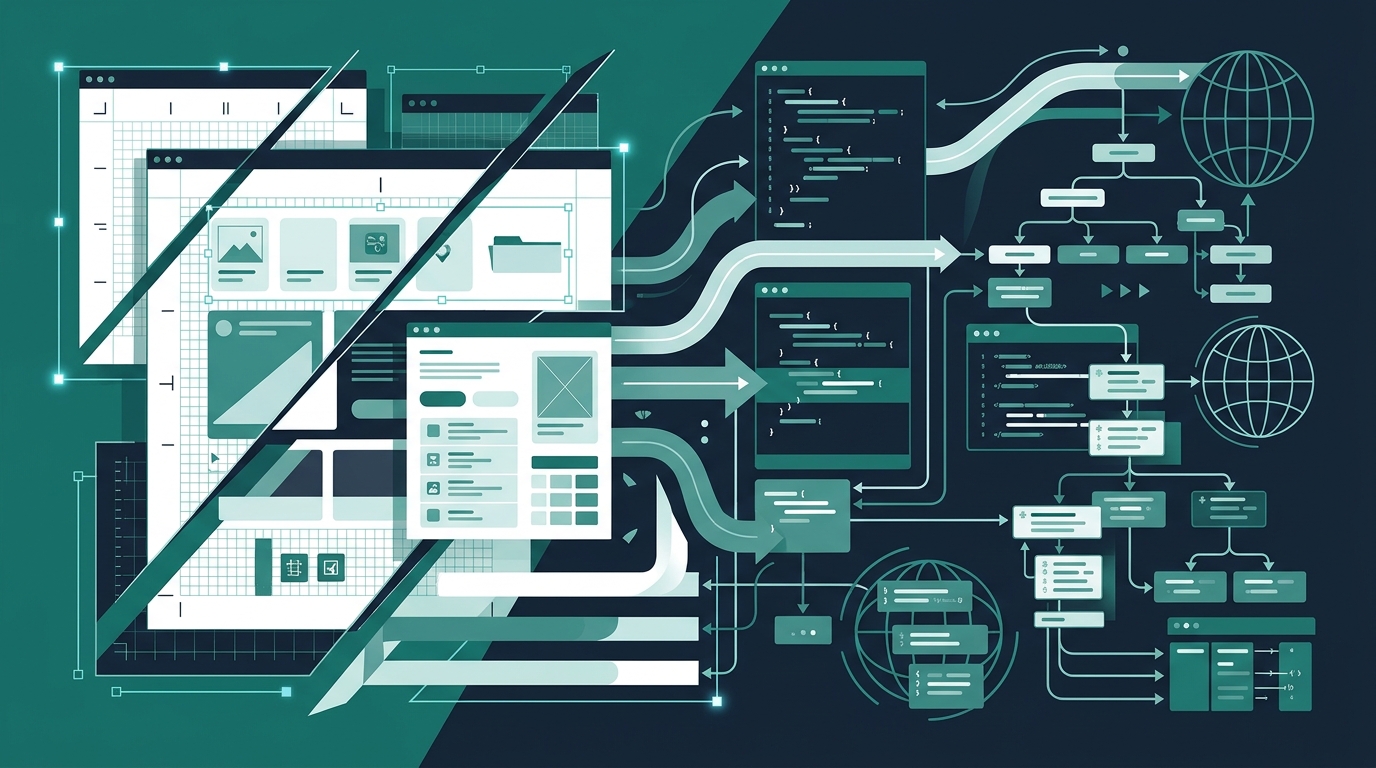
Let's compare the two paradigms side-by-side:
A request arrives. The server spins up an execution runtime, queries an underlying SQL database, executes dozen of plugin hooks, evaluates dynamic access control lists, parses on-page AEO rules, generates structured data on the fly, and returns a 1.2MB HTML payload wrapped in hundreds of vendor-specific CSS and JavaScript bundles. TTFB ranges from 400ms to 1,500ms. If crawler traffic spikes, database connection pools exhaust, causing intermittent 503 errors that wipe out search indexing.
A request arrives at an edge worker running within 20 milliseconds of the bot. The pre-rendered HTML document is served directly from memory. The payload is under 45KB. Semantic elements—<article>, <header>, <pre>, <code>—are cleanly organized without unnecessary nesting. JSON-LD structured data is statically validated during the build step using TypeScript schemas, guaranteeing zero syntax errors. TTFB is under 40 milliseconds across all global points of presence.
Which source do you think an AI ingestion pipeline prefers when querying real-time documentation? The fast, deterministic endpoint wins every single time.
If you want your technical blog to be the canonical source that LLMs, developers, and search algorithms quote, ignore the marketing noise around 'AEO software suites.' Instead, focus on these five core technical implementations:
Stop wrapping your code blocks in proprietary interactive widgets that require 300KB of React hydration to display simple syntax highlighting. Use standard <pre><code> structures with pre-rendered server-side highlighting (using tools like Shiki). Ensure every H2 and H3 heading has a stable, human-readable id anchor tag. AI crawlers use anchor fragments to directly link users to specific paragraphs inside their synthesized answers.
Never rely on a CMS to invent structured data at runtime. Author your JSON-LD schemas as part of your content build pipeline. For technical blogs, maintain rigorous TechArticle schemas with explicit dependencies, proficiencyLevel, and verified author entities pointing directly to an authoritative personal knowledge graph URL (such as a GitHub profile, LinkedIn URL, or verified personal domain).
Instead of hoping crawlers decipher your visual styling, implement the emerging /llms.txt and /llms-full.txt specifications at your site root. Provide a curated, markdown-only index of your publication's core technical guides, architecture overviews, and code references. By serving raw, unformatted markdown to authorized AI agents via clean HTTP endpoints, you bypass rendering overhead entirely and deliver pristine text directly to the model's context window.
If you translate your content, ensure every localized page contains bidirectional <link rel="alternate" hreflang="..." href="..." /> references, including a self-referential tag and an explicit x-default fallback. Test these references with custom shell scripts or automated CI checks on every deploy. If a single URL in your hreflang cluster returns a 404 or a 301 redirect, search engines will invalidate the entire language cluster.
Use modern Content Delivery Networks (CDNs) with instant cache purging capabilities via webhooks. When you publish an update to a technical tutorial or correct an errant code example, your edge cache should invalidate that asset globally in under five seconds. AI search bots crawl breaking news and trending bug fixes relentlessly; serving stale 304 responses because your CMS cache is stubborn directly harms your authority.
The sudden influx of 'AEO Studios' in platforms like Liferay is a classic enterprise playbook move: identify an emerging technological shift that terrifies marketing directors, package an existing set of mundane features under a trendy three-letter acronym, and promise a shortcut to organic dominance.
Do not fall for it.
Technical SEO in the era of artificial intelligence search is not about appeasing a new breed of mysterious algorithms with proprietary software. It is about doing the foundational engineering work that developers have championed for years: building lightning-fast, accessible, semantically pure web applications that respect the crawler's resources.
Audit your server response times. Strip out the dead weight in your DOM trees. Validate your schema pipelines in version control. Build a publication engine that prioritizes raw performance over administrative bloat. When you treat technical visibility as an engineering discipline rather than an editorial gimmick, you won't need an 'AEO Studio' to dominate search results.






Leave a Comment